
Available for pickup: Potted fruit trees, including named varieties of loquat, cold hardy avocado, jaboticaba, rare mulberry varieties, and more.
The nursery is a very small, one-person operation. Open by appointment only, in Citra Florida. If you see anything you want to buy, make a list of what you are interested in and send it to me via the contact page. I’ll get back to you confirming availability, and we can set an appointment time for you to stop by the nursery in Citra to pick up your plants.
Avocado (Persea americana subsp. drymifolia)
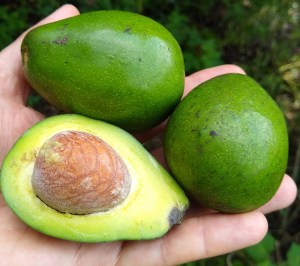

These are selections of the Mexican subspecies of avocado (Persea americana subs. drymifolia), which are more cold tolerant than commercially grown varieties. Mature trees can take winter lows (at least briefly) down to about 18F, while ‘Del Rio’ might be slightly more cold hardy – I’ve seen it handle dips to 15F with minimal damage.
Fruits are somewhat smaller than commercial types, with a larger seed. but they tend to have a higher oil content which gives them a more rich flavor. They have a very thin, edible skin, so you can eat them skin and all like an apple, or mash the flesh and skin together to make guacamole or avocado toast.
Unlike other types of avocado, Mexican varieties seem to prefer light shade their first few year (at least shade from the mid-day Florida summer sun). You can achieve this by planting just north of another tree, or by placing shade cloth on a structure over the avocado for its first two years. Once the plant gets about 8-10 feet tall, it can handle full Florida sun. Avocado trees are sensitive to wet feet – make sure to choose a planting location that is not subject to saturated soil after heavy rain events. If necessary, build up a mound of soil and plant your avocado tree on that.
For more extensive information on growing cold hardy avocados, see this article I wrote about them.
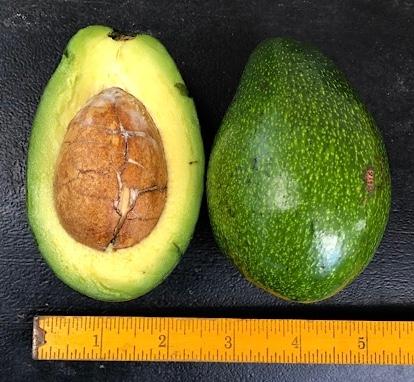
‘Del Rio’ Green-skinned fruits 3-4 ounces, occasionally 5 ounces. Flesh is extremely dense, rich, and oily. Makes an excellent guacamole when mashed with juice of sour orange and dash of salt. Hardy to about 15F when a mature tree.
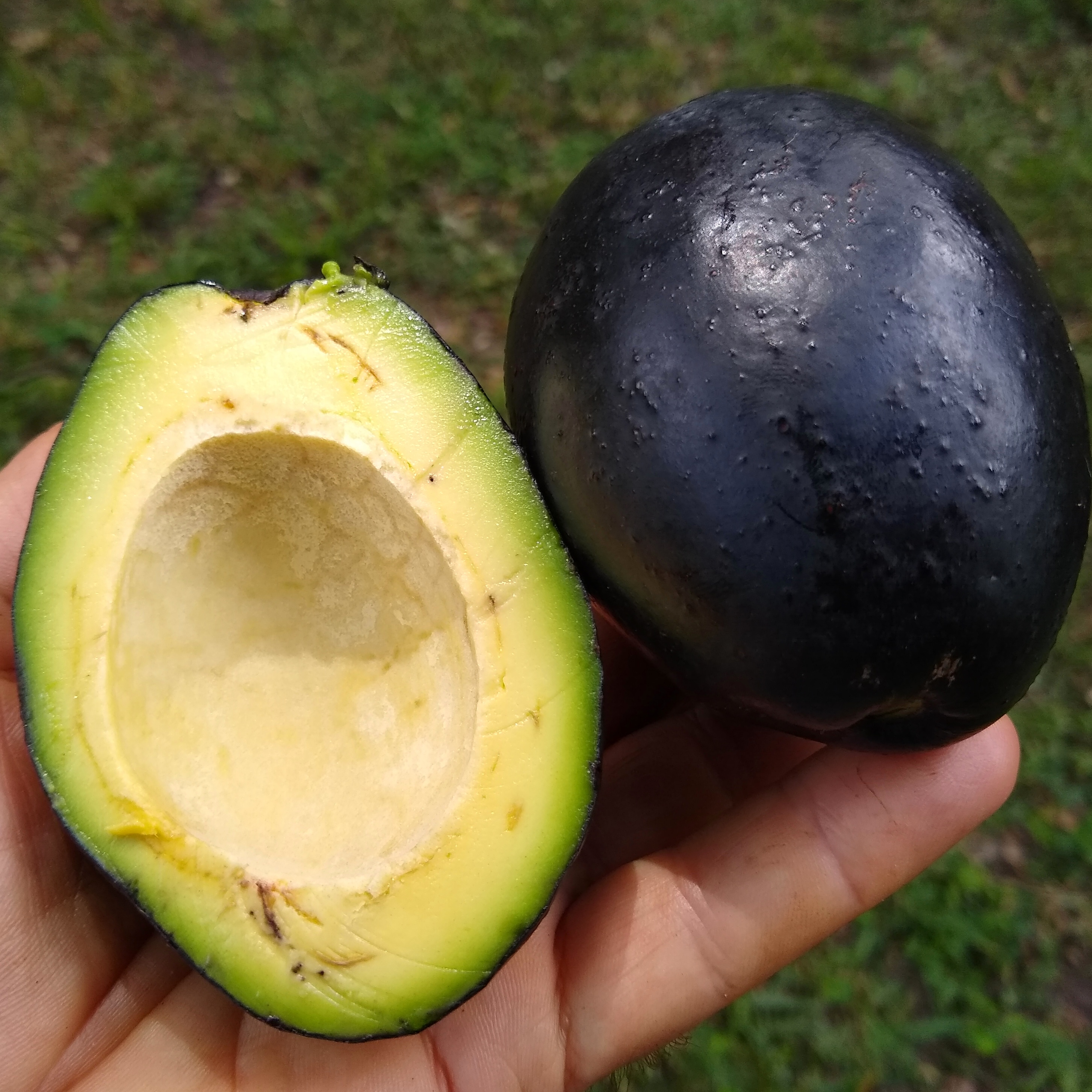
‘May’ Skin turns black at maturity, letting you know when to harvest. Very good flavor. Seems to be similar to and possibly identical to the variety ‘Joey’ – both cultivars came from Uvalde, Texas.
‘Jade’ A new variety, probably a cross between ‘Gainesville’ and ‘May’. Skin turns black at maturity. Limited experience so far indicates this variety has good flesh-to-seed ratio and exceptionally delicious flavor, with a smoothy creamy quality that I call “mayo texture”.
‘Tyner’ A new variety from Mack Tyner’s yard in Gainesville, Florida. Excellent quality fruits produced in abundance. Pretty good flesh to seed ratio, flavorful avocados with a slightly thicker skin than most pure Mexican subspecies avocados that gives it more resistance to anthracnose spots that can show up on some of the other varieties. Parentage is uncertain, it appears to be mostly Mexican subspecies, possibly with some genes from one of the other two subspecies of avocado. Crushed leaves have a distinctive floral scent rather than the anise scent of foliage of most Mexican avos. Mack reports the tree has handled 18F without problem.
‘Del Rio’ avocado, 3g grafted or air layered: $70
‘May’avocado, 3g grafted: $55 (sold out, message me to be notified when available)
‘Jade’ avocado, 3g grafted: $70 (sold out, message me to be notified when available)
‘Tyner’ avocado, 3g grafted, $70
Banana (Musa sp.)

‘Dwarf Orinoco’. This has proven to be a reliable producer of fruit in North Florida. At maturity the trunk is about five to six feet tall, and the leaves extend another five feet or so upward and outward. Also known in many areas as Burro banana, this is a plantain-like type, great for cooking. If you let the fruits get very ripe, they are also great for eating out of hand.
‘Tall Orinoco’ The traditional form of the Orinoco banana. Fruits are identical to those of ‘Dwarf Orinoco’, but the trunks are much taller, 8-10 feet, with the leaves reaching up and out another six or eight feet. A very durable banana variety for North Florida. Great if you want a taller banana planting for an elegant tropical look in addition to fruit production.

‘Dwarf Namwah’ is one of my favorite banana varieties for this area of North Florida. Plants are short, about five feet tall, with the leaves reaching another five feet for a total height of ten feet. Banana clusters emerge right at eye level. Flavor is outstanding, a true dessert banana.
‘Rajapuri’ is another outstanding dwarf growing variety that makes exquisite dessert quality bananas.
‘Dwarf Orinoco’ banana, 3g $35
‘Tall Orinoco’ banana, 3g $35
‘Dwarf Namwah’ banana 3g $35
‘Rajapuri’ banana 3g $35
Australian Beach Cherry (Eugenia reinwardtiana)
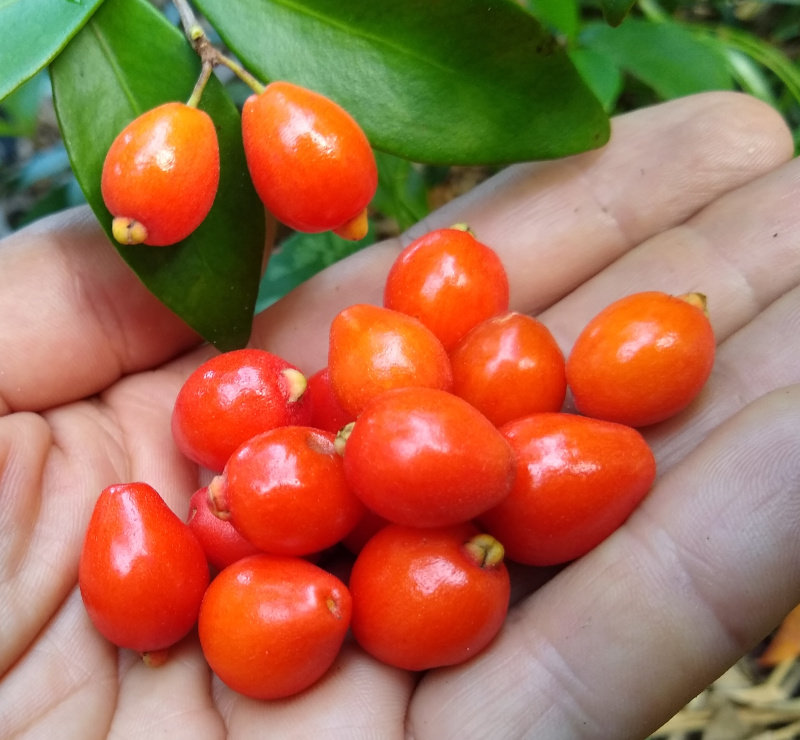
Australian beach cherry, also known as Cedar Bay cherry, is a shrub native to forests and beaches of northern Australia and a number of Pacific islands. The plant is a cousin of other tropical “cherries” like pitanga (aka Suriname cherry), pitomba, grumichama, and cherry of the Rio Grande. This slow growing shrub is quite ornamental, and it produces multiple crops a year of orange, cherry like fruits. The flavor is pleasant, a bit reminiscent of good temperate zone true cherries (not quite as good as them, but close). Flesh to seed ratio is ok, but better when the plant is well watered growing in good soil. These plants can produce quite a lot of fruit growing in a pot, so this can be a good tropical fruit tree to grow in a container. They seem to come true to seed, so the plants I am offering are seed grown. The price reflects the slow growth rate – these are just reaching fruiting size in a three gallon pot, but are probably 3-4 years old from seed.
Australian Beach Cherry: 3g $85
Common Fig (Ficus carica)

‘Alma’ Bred by Texas A&M University in the 1970s as a high quality dessert-like fig for the hot, humid conditions of the Southeastern US. It’s actually a cross between the main edible fig Ficus carica, and the closely related species Ficus palmata. On the outside, ‘Alma’ doesn’t look as pretty as some figs – the skin tends to develop splotches of brown as it ripens. But don’t let the exterior fool you. The amber flesh is wonderfully sweet, like honey mixed with notes of caramel, and a luscious, melt-in-your-mouth texture. A nice feature of this variety is that the “eye” of the fig often exudes a drop of sweet, honey-like resin that seals the fruit off from insects and souring that can get into open-eye types of figs in our rainy summers.
Plants I have of ‘Alma’ this year are own-root, so be aware of that if your property has especially bad nematode issues.

‘Celeste’ One of the two classic Southern figs, (the other being ‘Southern Brown Turkey’), ‘Celeste’ has smallish fruits with intensely concentrated sweetness and flavor. Remarkably, I’ve seen fruits of the variety dry on the tree during the steamy heat, humidity and daily rains of July in Florida (assuming humans and birds miss harvesting them). How do they manage to dry out in such conditions? I don’t know. I prefer the taste of ‘Celeste’ to ‘Southern Brown Turkey’, I think the flavor is more consistently delicious and sweet like honey, while SBT fruits can sometimes run a bit watery and bland tasting. Plants I offer of ‘Celeste’ are own-root, so keep that in mind if your planting area has especially bad nematodes.
‘Smith’ This is a new-to-me variety that I am offering for the first time. The word among fig enthusiasts is that ‘Smith’ has extremely good quality fruits, and ripens them well in the humid conditions of the Southeast, even in South Florida. I haven’t yet gotten to taste fruits of ‘Smith’, so I am relying on other people’s reports that this is an excellent variety for Florida. Plants I offer of ‘Smith’ are own root, so keep that in mind if your area has bad nematode issues.
‘Alma’ fig, 3g own-root: $35
‘Celeste’ fig, 3g own-root: $35
‘Smith’ fig, 3g own-root: $45
Guava, Cattley (Psidium cattleyanum)

Cattley guava is a more cold hardy cousin of the common tropical guava. Cold hardy to around the low 20s F, this species has proven itself a reliable producer in my area. Flavor is similar to tropical guava, although it lacks the intense tropical fragrance that some guavas have. Fruits are smaller usually 1 to 1.5 inches diameter. I usually have plants of both red fruited (“strawberry guava”) and yellow fruited (“lemon guava”) available. Despite those evocative common names for these color variants, I don’t detect much difference in flavor between the red and yellow forms. Fruiting season is typically in August. Plants grow into a shrub to small tree. Unlike many fruiting plants, these can make crops even in partial shade.
Cattley Guava, red fruited form, 3g $35
Cattley Guava, yellow fruited form, 3g, $35
Jaboticaba (Plinia/Myrciaria spp.)


Native to Brazil, jaboticaba is extremely popular and beloved by many in its home country. The plants grow as a shrub to small tree, and fruits look like big round grapes growing right out of the tree trunk. Taste is a bit like a really good grape, with tropical spice.
Jaboticaba plants can take winter lows dipping to about the mid 20s F, and will need protection during freezing weather which dips below that level. They are usually not large plants in Florida , so they are easy to cover – usually not more than about ten feet tall here (although they can get much bigger in their homeland of Brazil). The plants are slow growing. They like moist soil and can handle wet feet.
Purple jaboticaba (Sabarah variety) has been grown in Florida for many decades. Plants start fruiting when it reaches about six to seven feet tall, and in North Florida usually makes one main crop a year in spring, with occasional fruits the rest of the year. Flavor is excellent.
Red jaboticaba is more precocious than the purple type, it starts fruiting at a younger age and smaller size than purple jaboticaba, once it reaches about two to four feet tall. Red jaboticaba can make multiple crops a year, so its total annual production is much higher than the purple form. Flavor is excellent, especially if you let the fruits ripen on the plant till they are almost a blackish red color.
Red jaboticaba: 3 gal $60 (Sold out, message me to be notified when available)
Kadushi cactus (Cereus repandus/peruvianus)

Also known as Peruvian apple cactus. In my opinion this is the best fruiting cactus for North Florida, and is an underutilized fruiting plant for this region. The eating experience is similar to many types of dragon fruit – texture is like shaved ice or watermelon with tiny crunchy seeds, flavor is mildly sweet with floral notes that remind me of roses and violets. (I prefer the flavor of these to the “prickly pear” types of genus Opuntia).
Unlike dragonfruit, kadushi plants can handle a hard freeze, tolerating temperatures down to roughly 20F (-7C) – the exact cold hardiness probably varies from cultivar to cultivar. Consequently, we can grow kadushi plants in this area out in the open in my area of North Florida., while dragonfruit would require substantial winter protection here. Another advantage of kadushi is that the plants are free standing, while dragon fruit is a vine that requires a structure to climb on.
Flavor of kadushi varies from plant to plant. I am selecting varieties with especially good tasting fruits and naming them as cultivars. So far the first varieties I have available are ‘Don Knight’ and ‘Alachua’. Both have good flavor and appear to be self pollinating. If you want to experiment with developing the next generation of improved kadushi varieties, I also have plants available that were grown from seed of my best flavored cultivars. They might require cross pollination from another cultivar, so I offer a special deal if you get two or more of the seedling plants.
‘Don Knight’ kadushi: 3g $40
‘Alachua’ kadushi: 3g $40
Kadushi grown from seed of excellent cultivars: 3g, $30, or two plants for $50
Lasura (Cordia myxa)
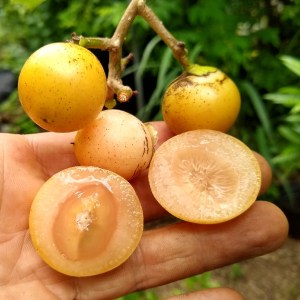
Lasura is a fairly obscure fruit from southern Asia. It’s kind of an oddball edible, with curious flavors and textures. Some people compare the taste to watermelon. The texture around the seeds is extremely sticky and glue-like. Some people who have tried this take one bite and say, “Nah, not for me.” Others say it’s appealing in an unusual way. “It’s weird but I like it” said one friend. This is a tropical tree and will suffer dieback at temps much below freezing. We’ve had so many mild winters in my area with little to no freezing that my tree has made occasional crops of fruit. I’d consider this one experimental in North Florida, more likely to be a reliable producer in Central or South Florida. It does not seem to need cross pollination – I’ve had an isolated tree produce crops of fruit.
Lasura, cutting grown 3g, $45
Loquat (Eriobotya japonica)

Loquat trees are commonly used as ornamentals in North and Central Florida. These landscape loquate trees were never selected for fruit production, so quality is varable. Named varieties have been selected for larger, sweeter fruit. My own selection ‘Ellen Marker’ resulted from a seed from Larry Shatzer’s breeding pool of improved loquat varieties. The seedling tree, planted in the ground at my place, took 15 years for first fruit production in 2019. It has large fruits with a good flesh to seed ratio, and an outstanding, distinctive flavor, among the best of any named variety loquat I’ve eaten. While most loquats to me taste like a peach-apricot mix, ‘Ellen Marker’ fruits taste like peach mixed with sweet table grapes, and a spritz of lemon. I’m excited to finally be able to offer plants of this for sale. (Note: fruit quality seems best when the developing fruits are not exposed to temperatures much below freezing, so this might not taste consistently as good in colder parts of North Florida.)
‘Ellen Marker’ loquat: 3g $65
Mulberry (Morus sp.)
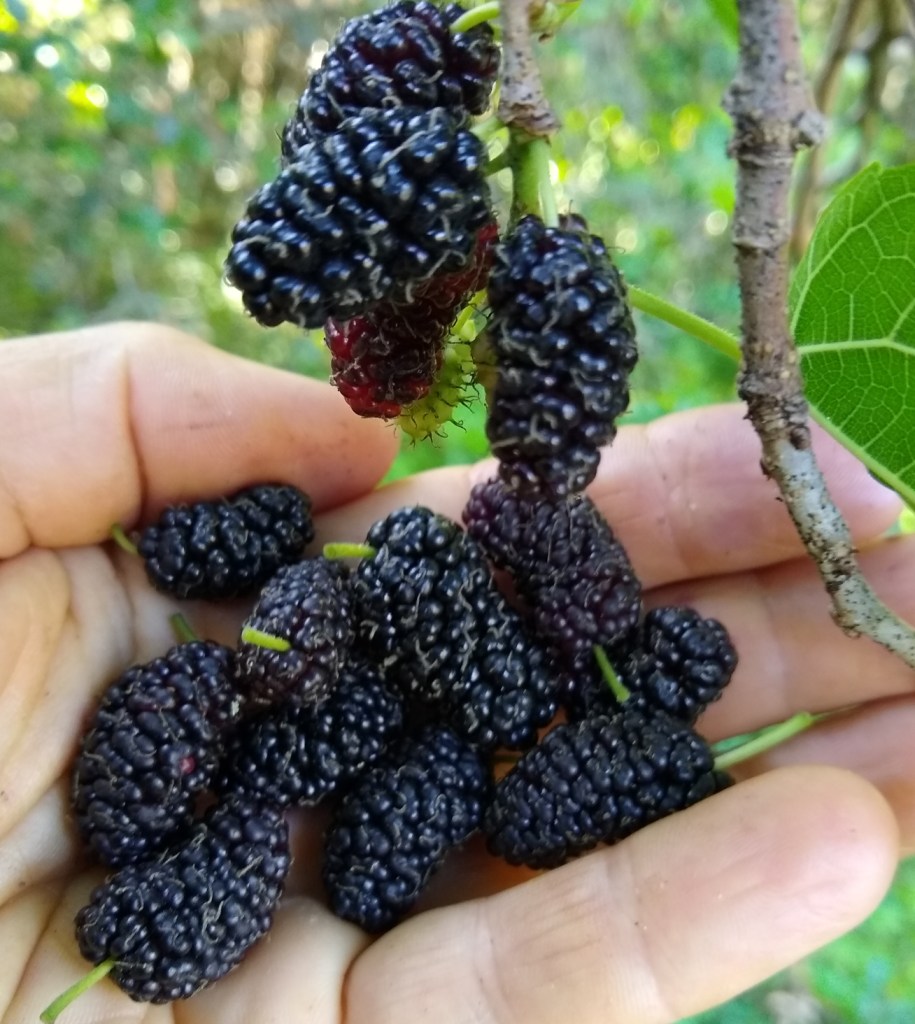
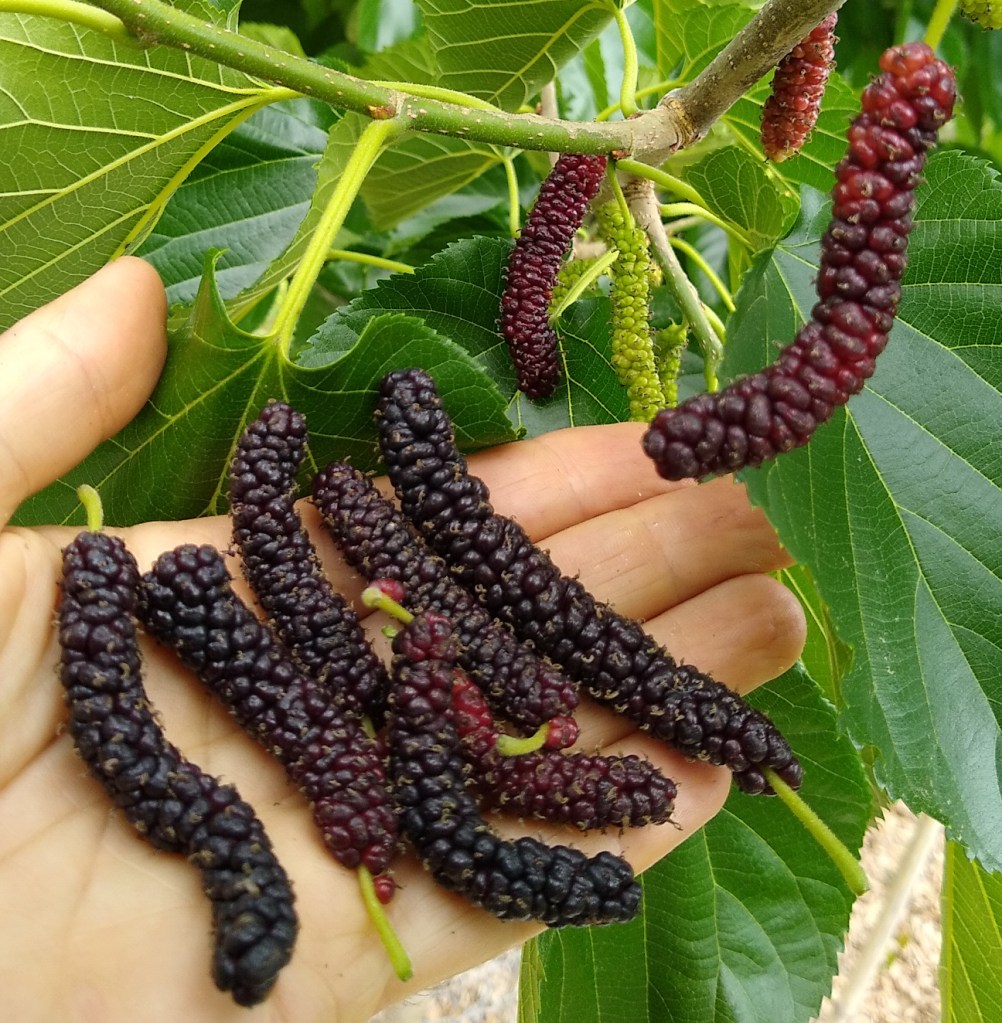

Mulberries are rapidly growing fruit trees that produce abundant quantities of sweet, antioxidant-rich berries. Mulberry trees like rich, moist soil, and can tolerate wet feet. Some varieties can handle extreme cold and grow in far northern areas. Others are adapted more to the tropics or subtropics. Mulberry drop a lot of fruits, which can stain anything underneath them, so they are best planted where the fruits won’t be landing on walkways, decks, driveways, or anyplace where that would be a concern.
‘Sixth Street’ is an old standby mulberry in North Florida. It reliably produces large crops of purple-black berries every spring with good sweet flavor. Probably a form of Morus alba. Nematode tolerant on its own roots.
‘Himalayan FSP’ is the outstanding form of Himalayan mulberry from the Fruit and Spice Park. It has the most delicious fruits of any mulberries I know, very sweet with intense berry-like flavors reminiscent of blackberry, cherry, Concord grape and fruit punch. Berries are three inches long. NOT the same as variety ‘Pakistan’, this cultivar has better flavor. I’ve only been growing this one a few years, and usually it stays dormant long enough to escape damage from late freezes, but at least occasionally it can break dormancy early, making it potentially susceptible to damage if there is a late freeze that year. Cold hardiness is uncertain, best guess is hardy to Zone 7 if it’s dormant when extreme cold hits. The plants I sell are grafted onto nematode-tolerant rootstock.
‘Skinner’ is a new variety in this area. Berries are finger-like, 4+ inches long. Flavor is nearly as good as ‘Himalayan FSP’. Plant is more precocious than ‘Himalayan FSP’, often fruiting in a 3-gallon pot. Reportedly if given a hard pruning after fruiting, it can make a second crop the same year. This variety is extremely prone to breaking dormancy during winter, so in North or Central Florida, it might be necessary to protect it from freezing weather if it is pushing tender growth. Grafted onto nematode-tolerant rootstock.
‘Green White’ has long, finger-like white fruits with a distinctive flavor. While other mulberries like ‘Himalayan FSP’ offer a concentrated array of berry-like flavors and combine a touch of fruity tartness with with sweetness, ‘Green White’ has a flavor a bit like honeydew melon, combined with intense sweetness, and no tart to balance the sweet. It’s a bit like honeydew melon with actual honey on it. Some people dearly love this flavor combo, while others find the lack of tart to balance the sweeter notes makes this one taste too sweet. This variety is similar and possibly identical to varieties in circulation under the names ‘White Shahtoot’, ‘Australian White’, ‘White HImalayan’, and ‘King White’.
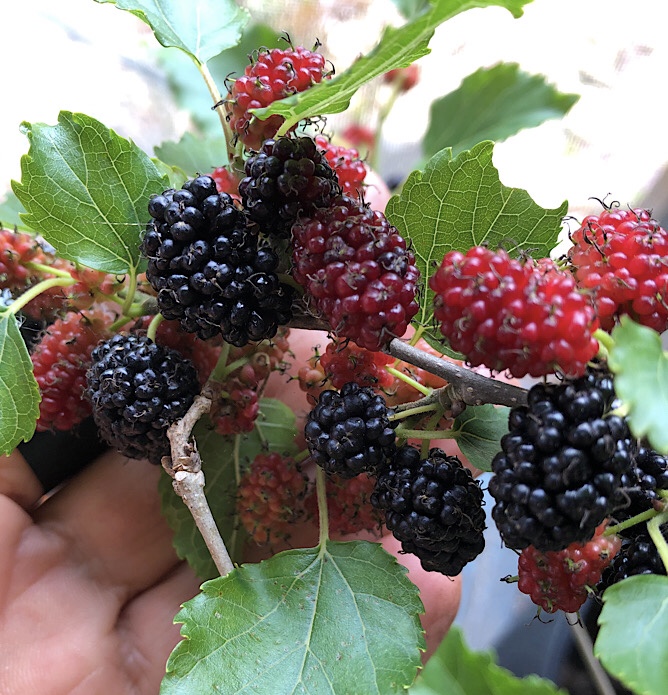
‘Thai Mustang’ is the name I’m calling a variety I got from a Thai couple at the now defunct Mustang Market around 2018. They said they didn’t know the variety name, but it came from Thailand (mulberries are grown commercially in that country). Presumably this is a Thai commercial variety. It has large, oval black fruits with very nice flavor. I don’t have a huge amount of experience with this variety yet, but so far the fruit size, flavor, and productivity seem promising. One interesting thing, the fruits seem slightly more durable than other mulberries, even when fully ripe, so this one might have been bred to sell the fruits commercially without them turning to mush like many mulberry fruits would. I have found that ‘Thai Mustang’ is nematode sensitive, so I am offering plants grafted onto nematode tolerant rootstock.
‘Sweet Delicious’ This is a new-to-me variety which I have not fruited yet, so my info on it is second hand. But it is reported to be an old time Florida variety with excellent flavor, and a large portion of its genetics are the native Morus rubra. I have a few grafted plants available fall 2025.
‘Sixth Street’ (own root) mulberry, 3g $30
‘Himalayan FSP; (grafted) mulberry 3g $60
‘Skinner’ (grafted) mulberry 3g $55
‘Green White’ (grafted & own-root) mulberry 3g: $55
‘Thai Mustang’ (grafted) 3g $55
‘Sweet Delicious’ (grafted) 3g $45
 Florida Bamboo & Fruit Trees